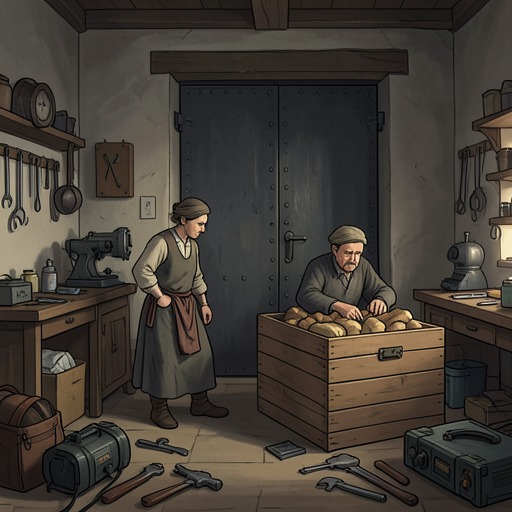
Florio Cinchona Bark Grinder
The Florios of SicilyThe Florio Cinchona Bark Grinder is a mechanical device Vincenzo brings into the Florio business to process cinchona bark more quickly and consistently. Its first demonstration turns an innovation he had described in correspondence into tangible evidence: the grinder can do in half an hour what takes five workers an hour, and it produces powder clean enough to be sold without sifting. The machine thus represents more than a faster tool. It links imported medicinal commodities, industrial processing, and the Florios’ pursuit of commercial standing in Palermo.
Trade and the need for processing
Spices and medicinal goods reached European markets through long and costly routes. Cinnamon or ginger might pass through dozens of hands, travel by mule or camel, and cross the ocean before reaching a port; every stage raised its price. By the beginning of the nineteenth century, British and French ships were bringing colonial goods into European harbors, broadening supply and lowering prices. Palermo’s spice merchants organized through the aromatari guild, while a growing number of sellers competed for the expanding market.
The Florios were part of these routes as wholesalers. They rented guarded warehouse rooms within the Palazzo Steri property, where spices could wait in transit or remain in storage until sale. Their stock included goods from India obtained through British suppliers and spices from French colonies, traded through Livorno and across the Tyrrhenian Sea. The warehouse arrangement also shaped their costs: import tariffs were paid only when goods entered Palermo, making the rented space a practical alternative to paying taxes earlier. The grinder belongs to this wider commercial system: it adds local processing capacity to a business already dependent on international supply and shipping.
The machine’s demonstration
Vincenzo returns home from work sweaty and marked with oil, but pleased, and asks Ignazio to accompany him the next morning with Maurizio Reggio and a worker carrying a sack of bark. He offers no explanation beyond promising that they will see. The device is an iron casing with a hermetic lid; inside, two large iron forms grind the bark. Vincenzo waits with his arms crossed as Ignazio examines it, and Reggio watches with fascination.
After the machine is stopped, the lid is lifted. Powder has collected beneath the metal plate. Ignazio is astonished by the speed: in half an hour, the grinder processes more bark than five workers can manage in an hour. Vincenzo explains that the method is used in England and that the powder is purer because the dregs remain at the bottom. It needs no sifting and can be collected directly in glass jars. Reggio tests the texture with a finger and is impressed. The sequence makes the device’s advantages concrete: higher throughput, a cleaner product, and fewer processing steps between raw bark and goods ready for sale.
Operation and commercial purpose
The demonstration ends with Vincenzo closing the lid again to prevent volatile elements from dispersing and asking for jars. He instructs that their tops be secured and marked with the Florio wax seal. The order connects the machine’s technical output to the firm’s practices of packaging and identification: the powder is not merely produced more quickly, but prepared in a form the business can handle as merchandise.
Vincenzo also plans to have the English worker train the Florio workers to use the grinder, after which the worker can return to Leeds with the next shipment. The device is therefore introduced not as a one-time display but as equipment intended for continued use by the firm’s own workforce. Its adoption depends on transferring the knowledge required to operate it, and its role is bound to the movement of people and goods between Palermo and Britain.
Labor, scale, and significance
The grinder’s stated efficiency makes labor comparison central to its significance: its output in half an hour exceeds what five workers produce in an hour. The narrative presents this difference as a business advantage, but it also shows mechanization changing how the Florios can organize production. Instead of relying only on manual grinding and subsequent sifting, they can process more bark with a machine and sell a more uniform powder in sealed jars. The account does not describe the eventual effects on staffing or employment, so the machine’s consequences for workers cannot be specified beyond this comparison and the plan to train them.
In the larger commercial setting, the grinder helps connect the Florios’ access to foreign goods with a new capacity to process them locally. Ignazio’s astonishment and his remark that England has done Vincenzo good register both the practical success of the invention and the nephew’s growth as a businessman. The machine gives that growth a material form: an iron device whose measurable speed and cleaner output make innovation legible as a route toward greater commercial reach.